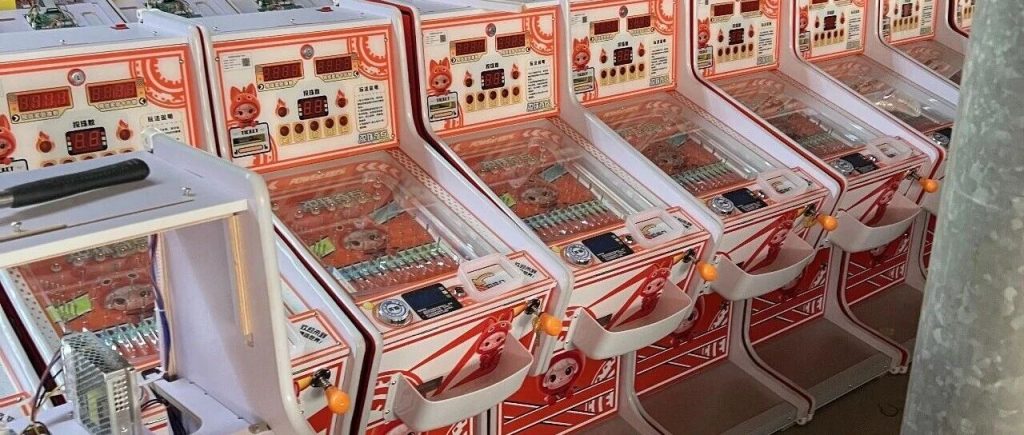
SMART-MODEL PACHINKO MACHINE MANUAL. 2025/8/1, Version 4.0.
I. GAMEPLAY.
1. Insert tokens to obtain balls, then insert the required balls and press the Start button to release a pinball and begin the game.
2. When you press Start, the multiplier lamp stops on the corresponding multiplier.
3. Shoot the pinball into the lit channel to win a reward equal to the inserted ball count multiplied by the multiplier; the game then ends.
II. SETTINGS.
1. There are 5 buttons on the mainboard; press K1 to enter settings.
2. In settings, K1 switches the setting item, K2 is setting “+”, K3 is setting “-“.
3. K4 enters accounting; in accounting state, hold K2 and K3 for 5 seconds to clear accounts.
4. K5 is the Back button.
5. When not in a game, K2 and K3 adjust the volume.
6. In standby, a short press of K5 drives the motor; another short press stops it.
7. In standby, holding K5 for 5+ seconds clears the remaining ball-return count.
8. In an error state, the Start button acts as the repair/refill button.
9. Hold K1 for 3 seconds to enter the level (dangwei) setting menu (takes effect when game mode is set to “level”). PARAMETERS TABLE — Name / No. / Range / Default / Notes. Game settings: Game mode A1, range 0–3, default 0: 0 = insert/return-ball mode; 1 = insert/return-ball + ticket mode (returned together); 2 = insert/return-ball + ticket mode (tickets only returned when enough points); 3 = ticket-return mode; 4 = insert/return-ball + ticket mode (return remaining balls); 5 = lucky partner mode; 6 = points; 7 = level. Coin settings A2, range 1–10, default 1: how many coins are inserted to exchange for balls. Ball-return setting A3, range 1–50, default 10: how many balls are dispensed per coin inserted. Ticket ratio A4, range 1–99, default 10: how many points return one ticket (tickets returned above the set points). Anti-shake A5, range 0–1, default 1: 0 = off; 1 = on. Difficulty A6, range 0–10, default 3: the higher the value, the harder; 7/8/9 are exceptions. Attract mode A7, range 0–3, default 0: 0 = off; 1 = small venue; 2 = medium venue; 3 = large venue. Insert limit switch A8, range 0–1, default 0: 0 = off; 1 = on — only as many balls as are returned may be inserted. Minimum insert A9, range 1–10, default 1: how many balls must be inserted to start a game. Button insert method 10, range 0–1, default 0: 0 = balls can keep being inserted and accumulated after the current round is confirmed; 1 = balls inserted after confirmation go to the next round. Accumulation 11, range 0–2, default 0: 0 = no point accumulation; 1 = accumulate points with power-off save; 2 = accumulate points without power-off save (only effective in mode 3). Pause on win 12, range 0–1, default 1: 0 = no — returns to standby after winning; 1 = yes — pauses 5 minutes after winning before standby. Standby music 13, range 0–1, default 1: 0 = off; 1 = on. Ticket cap 14, range 0–10, default 0: 0 = no cap; other values = ticket cap. Multiplier probability 15, range 0–7, default 4: see table below. Lamp-count mode 16, range 0–1, default 0: 0 = fixed; 1 = random. Grand slam 17, range 0–1, default 0: enables grand-slam gameplay. Language 18, range 0–1, default 0: 0 = Chinese; 1 = English. Print 19, range 0–1, default 0: 0 = print (no ball return); 1 = Haoku; 2 = Leyaoyao. Max insert 20, range 1–99, default 99: maximum balls insertable in one round. LEVEL SETTINGS — Level 1 score b1, range 10–1000, default 100: target score for level
1. Level 2 score b2, default
600. Level 3 score b3, default
990. Level 4 score b4, default
990. Level 5 score b5, default
990. Level 6 score b6, default
990. Level 1 ticket count b7, range 1–1000, default 10: tickets returned at level
1. Level 2 tickets b8, default
100. Level 3 tickets b9, default
300. Level 4 tickets b10, default
300. Level 5 tickets b11, default
300. Level 6 tickets b12, default
300. ACCOUNTING — C1 total coins inserted; C2 total balls inserted; C3 total balls returned; C4 total tickets returned. (Multiplier lamp-count and probability tables and the per-level lamp/channel arrangements are retained numerically and are intended for technicians; values unchanged.)
III. ERROR CODES. E1 Shake error:
1. Check whether the shake sensor is short-circuited and properly installed.
2. Check whether the machine is level. E2 Ball-return photo-eye error:
1. Check whether the ball-return photo-eye wiring is loose or misplugged.
2. Check whether a foreign object blocks the photo-eye.
3. Check whether the photo-eye is abnormal and replace it promptly. E3 Ball-return timeout error:
1. Check the photo-eye wiring for loose/misplug.
2. Check whether balls are running low and refill promptly. E4 Channel error:
1. Check whether the winning-channel board is connected to the mainboard.
2. Check whether the winning-channel board microswitch is normal. E5 Ball-insert photo-eye error:
1. Check the insert photo-eye wiring for loose/misplug.
2. Check whether a foreign object blocks it.
3. Check whether it is abnormal and replace promptly. E6 Ticket-return timeout error:
1. Check the ticket-return wiring for loose/misplug.
2. Check whether tickets are running low and refill.
3. Check whether the ticket machine is faulty; try replacing it. E9 Printer out of paper:
1. Check whether the printer is out of paper and refill promptly.
IV. PIN DIAGRAM (Mini Pachinko – Mainboard): J2 — pin 1 empty (to power box); pin 2 GND ground; pin 3 12V 12V power input. J3 — pin 1 12V 12V output; pin 2 DO lamp driver; pin 3 GND ground. J1 — pin 1 SER, pin 2 SRCLK, pin 3 RCLK (digital tube, reserved); pin 4 5V output; pin 5 12V output; pin 6 GND ground. J11 — pin 1 12V start-button lamp power; pin 2 LD1 start-button lamp driver; pin 3 KE16 start-button signal; pin 4 GND start-button ground; pin 5 KE17 print-button signal; pin 6 KE18 anti-shake signal (to shake sensor); pin 7 GND coin acceptor ground; pin 8 KE19 coin signal; pin 9 AUD− audio−; pin 10 AUD+ audio+. J7 — pin 1 GND ground; pin 2 RX2 receive 2; pin 3 TX2 send 2; pin 4 5V output (serial port 2, reserved). J10 — pin 1 LM+ solenoid driver (to solenoid); pin 2 LM− solenoid driver. JP1 — ribbon cable to the channel-detection lamp board. J8 — pin 1 12V; pin 2 12V output (to ticket machine); pin 3 LD2 ticket machine input; pin 4 KE15 ticket machine output; pin 5 GND ground. J12 — pin 1 5V ball-insert photo-eye power; pin 2 GND ball-insert photo-eye ground; pin 3 KE14 ball-insert photo-eye signal; pin 4 12V 12V output to coin acceptor. J9 — pin 1 5V ball-return photo-eye power; pin 2 GND ball-return photo-eye ground; pin 3 KE13 ball-return photo-eye signal; pin 4 12V. J6 — pin 1 M1+ ball-return motor+ (to ball-return motor, 12V recommended); pin 2 M1− ball-return motor−; pin 3 VDD 12V–24V power input; pin 4 GND ground; pin 5 M2−; pin 6 M2+.